
I have completed a Diploma of Aircraft Maintenance Engineering – Mechanical TB1 and/or Diploma of Aircraft Maintenance Engineering – Avionics TB2. Why do I not have full credit against my MEAs?
It is important, first and foremost, to appreciate that the MEA units of competency are all housed within the Aeroskills Training Packages. All qualifications which include the requirement of MEA units of competency are included within these training packages, e.g. Certificate IV in Aeroskills (Mechanical) or Diploma of Aeroskills (Avionics). It is noteworthy that these two example qualifications also have the MEA code in their qualification identifier (MEA40718 and MEA50118 respectively). In general, any Australian endorsed qualification relating to aircraft maintenance fall under the umbrella Aeroskills training packages (coded MEA) and recognised nationally under ASQA. These qualifications (and constituent units) are delivered by multiple RTOs across Australia.
The confusion with the Diploma of Aircraft Maintenance Engineering – Mechanical TB1 and Diploma of Aircraft Maintenance Engineering – Avionics TB2 starts with the nomenclature, specifically with the use of the term “Diploma” in the course title, and the reference to “Aircraft Maintenance Engineering”. As described already, all Australian qualifications relating to aircraft maintenance engineering fall under the Aeroskills package. In fact, even a quick look the two courses above will show that they are each officially categorised as an “Accredited Course”. This is different to a “Qualification” which is applicable to the standard Aeroskills Training Package products.

An accredited course can be produced and registered with training.gov.au by any training provider where there is a specific purpose for its delivery, and as shown in the extract above, the training cannot be met through a nationally endorsed training package qualification. This is clearly the intention with the both the Diploma of Aircraft Maintenance Engineering – Mechanical TB1 and Diploma of Aircraft Maintenance Engineering – Avionics TB2, which have been specifically developed to provide training towards an EASA licence outcome.
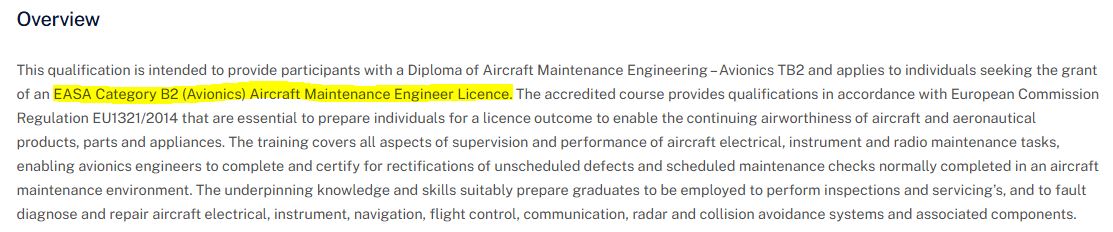
By comparison, many of the Aeroskills Units of Competency (MEAs) are mandated by CASA to achieve a CASA licence outcome, and by DASA to achieve a DASA MAML (Military Aircraft Maintenance Licence). Note, importantly, that many of the Aeroskills Units of Competency (MEAs) do not form part of any CASA or DASA licencing requirement and simply lead to specific Aeroskills Qualifications, a common example being the Certificate IV in Aeroskills (Structures).
Under the Nationally Recognised Training (NRT) framework, credit is always applicable between registered training organisations (RTOs) where units of competency are equivalent. For example, if a student has achieved MEA301 Perform aircraft flight servicing under nationally recognised training at a registered training organisation, they will automatically be eligible to receive credit for the same (or equivalent unit) at another RTO. In some cases, the unit may have been superseded by a newer version, but training.gov.au will implicitly state that the new unit “supersedes and is equivalent to” its predecessor. An example of this is shown below where MEA301C has been superseded by the equivalent unit MEA301.
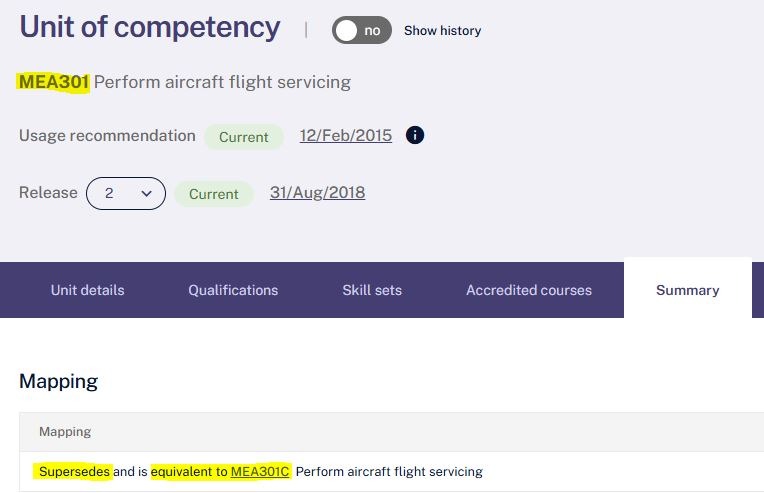
In these cases, credit is simply applicable on the basis of the unit summary.
Wherever credit is applied, it is done on a unit of competency-to-unit of competency basis. Credit will never (and cannot) be applied on a qualification-to-qualification basis. Consider the following example, where a student may have fully completed a Diploma of Aeroskills (Avionics), and subsequently seeks a Diploma of Aeroskills (Mechanical). Assuming they have completed all the units for the Diploma of Aeroskills (Avionics), they will be entitled credit for many of the units of competency (MEAs) required by the Diploma of Aeroskills (Mechanical) as they are equivalent.
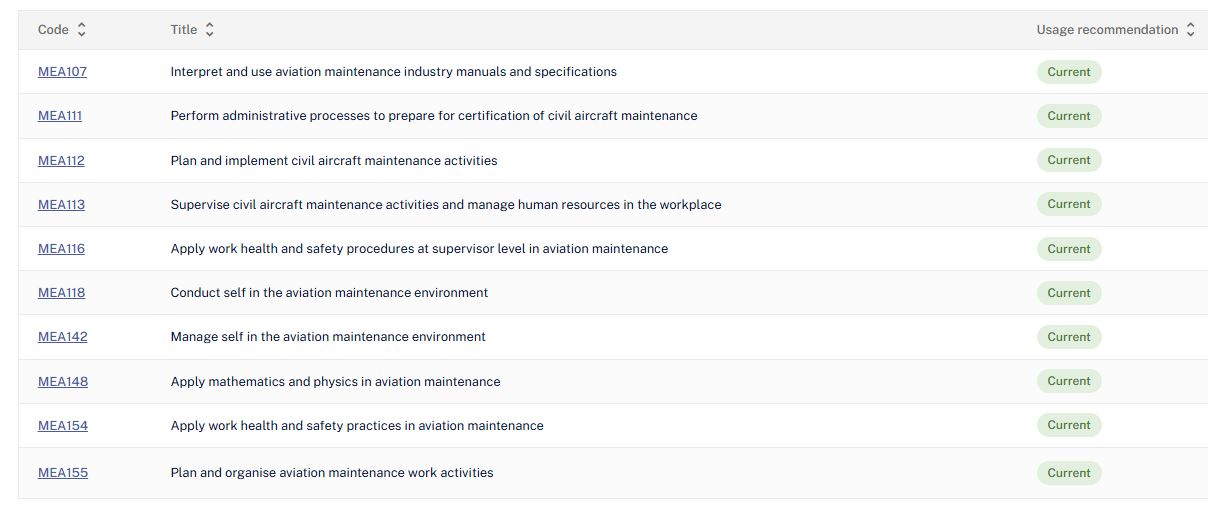
Once all the MEAs for the Diploma of Aeroskills (Mechanical) have been satisfied, the student will be awarded this qualification.
It is important to note that qualifications, and their subsequent unit requirements, change with the release of new versions. This is the reason why a qualification can not be directly credited on the basis of its level (or indeed name) under the Australian Qualification Framework (AQF). As an example, earlier versions of the Certificate IV in Aeroskills (Mechanical) (e.g. MEA40707) did not have the requirement to complete the environmental unit MSMENV272 (or its preceding equivalents). However, all the AQF level equivalent Certificate IV in Aeroskills (Mechanical) beginning with the MEA40711 version on onwards do require this unit (or its earlier versions) as a core unit. While the level of qualification under the AQF remains consistent, and implies a certain level of tradesperson, the actual requirements are subject to change over time.
Let us now turn our attention back to the Diploma of Aircraft Maintenance Engineering – Mechanical TB1 and Diploma of Aircraft Maintenance Engineering – Avionics TB2. Looking into the details registered on training.gov.au, it transpires that minimal information available. In particular, there is no indication that any MEA units of competency have been completed. This is consistent with the fact that these courses fall outside of the MEA training package qualifications.
As there are no specific unit details, it is impossible to provide any credit directly from the TB1 and TB2 Diplomas to any Aeroskills training products.
In fact, the TB1 and TB2 diplomas comprise units which resemble the Aeroskills units, but are not demonstrably equivalent.
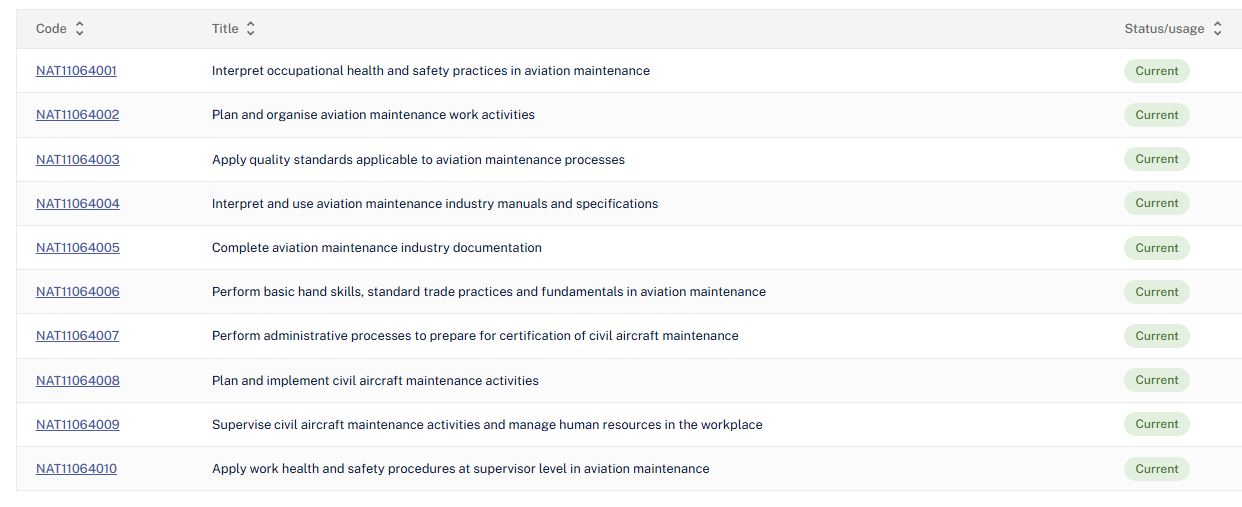
The lack of information regarding the unit details is shown by opening a unit for comparison (e.g. NAT11064001). No information is available within this unit around the requirements (e.g. assessment requirements, performance evidence, knowledge evidence and assessment conditions). Compare that to the extensive information provided within MEA107.
While some (or even many) of the tasks completed towards the TB1 and/or TB2 diploma units may be applicable to specific tasks required by the MEA units of competency, merely holding the Diploma of Aircraft Maintenance Engineering (and its self-contained units) provides no means of providing direct credit against Aeroskills MEA units.
Ready to put this into practice?
Choose your mechanical or avionics diploma stream and apply through the RPL and gap pathway.
Choose my diplomaNeed help choosing? Enquire with our teamUseful links
College course information and CASA guidance for further reading.
0 readers found this helpful